
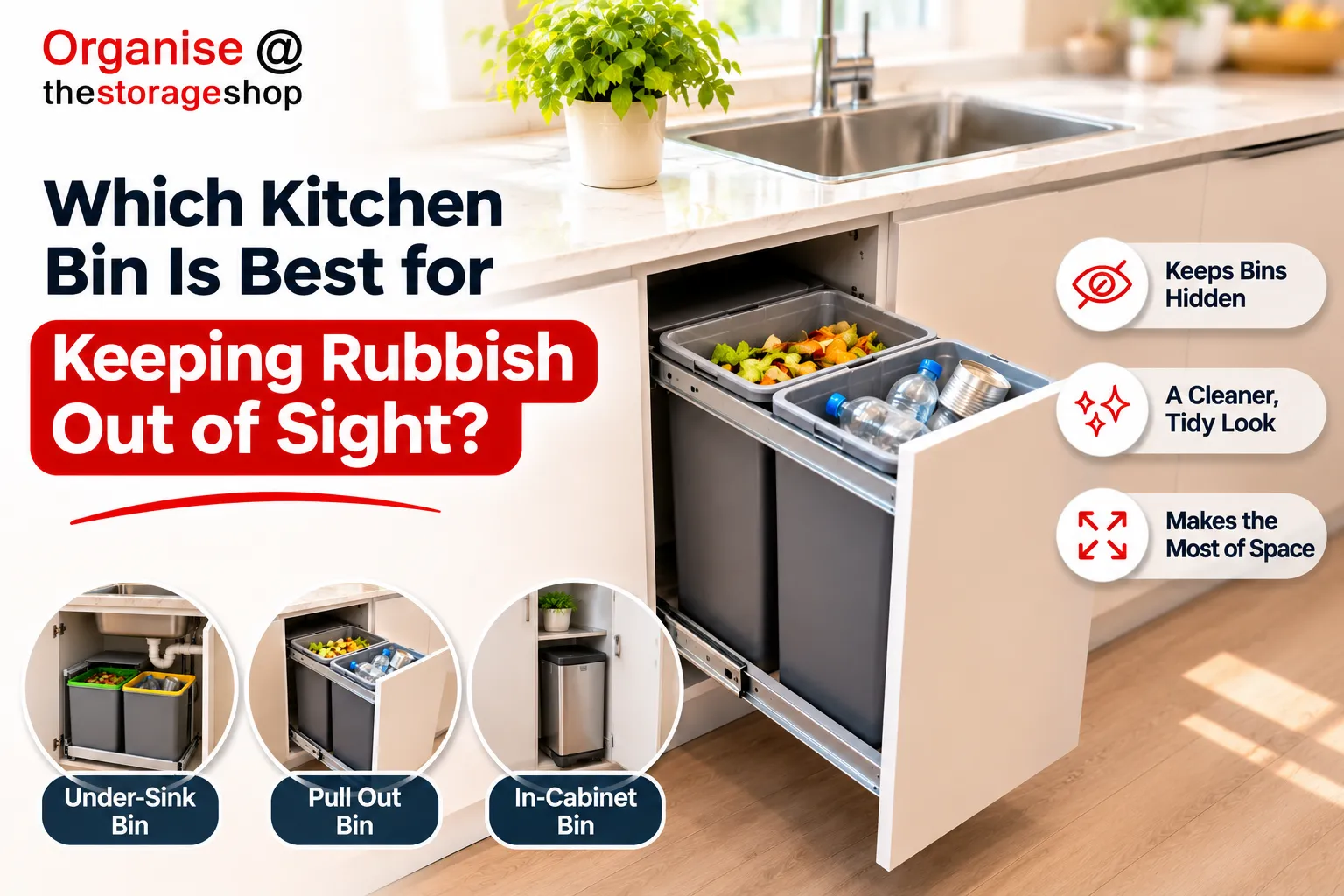
Short answer: A pull out bin inside a base cabinet hides rubbish best. It’s invisible when the door is shut, holds plenty, and keeps rubbish and recycling in one place. A door mounted bin is the better fit when you’re short on cabinet space, and a low bin under the sink suits kitchens where the plumbing leaves enough room.
You can have beautiful benchtops and handleless cabinets, and the first thing a visitor notices can still be the bin by the fridge. A truly hidden kitchen bin doesn’t just sit behind a door. Nothing gives it away: no lid on show, no bag sagging over the rim, no smell, and no clatter every time someone opens it.
What gives a kitchen bin away?
-
Sight: a freestanding bin, however nice, is still a bin.
-
Smell: food scraps left for days will find their way out of any cupboard.
-
Sound: a lid that slams or runners that rattle draw attention every time.
-
Mess around it: drips, stray packaging and a recycling crate parked next to it.
A good hidden setup deals with all four, not just the first.
Three ways to hide a kitchen bin
1. A pull out bin in its own cabinet
This is the most complete solution. The buckets sit in a frame on runners inside a base cabinet. Some models screw to the cupboard floor and slide out once you open the door. Others fix to the back of a drawer-style front, so one pull brings everything out.
Why it hides rubbish so well:
-
Nothing visible. The cabinet front matches the rest of the kitchen.
-
Room for every stream. Two to four buckets keep general waste, recycling and food scraps together, so there’s no crate on the floor.
-
Quiet. Soft-close runners stop the bin banging shut.
A 300 mm cabinet takes a slim unit of roughly 16 to 34 litres. A 600 mm cabinet can hold up to 94 litres across four buckets. You can compare sizes across the pull out bin range.
The catch is that it uses up a whole base cabinet, so you’ll need somewhere else for those pots or trays.
2. A door mounted bin
If you can’t spare a full cabinet, a door mounted bin attaches to the cupboard front instead of the floor. Smaller swing-out versions, usually 5 to 20 litres, hang inside a hinged door and come out as it opens. Some lift their own lid on the way.
It works best for:
-
food scraps beside the prep area
-
narrow cupboards where a frame won’t fit
-
a second bin, such as a scraps bin near the sink while the main bin sits elsewhere
Check that the door, hinges and clearance can take the extra weight before you buy. Browse door mounted bin styles to find one sized for your cupboard.
3. A bin under the sink
The sink cupboard is where most scraps start, so it’s a natural hiding spot. The difficulty is everything else in there: the waste trap, hoses, taps and usually a stash of cleaning products.
A low pull out unit or a swing-out door bin usually fits better than a full-height frame. Measure from the cupboard floor to the bottom of the trap before you choose a height.
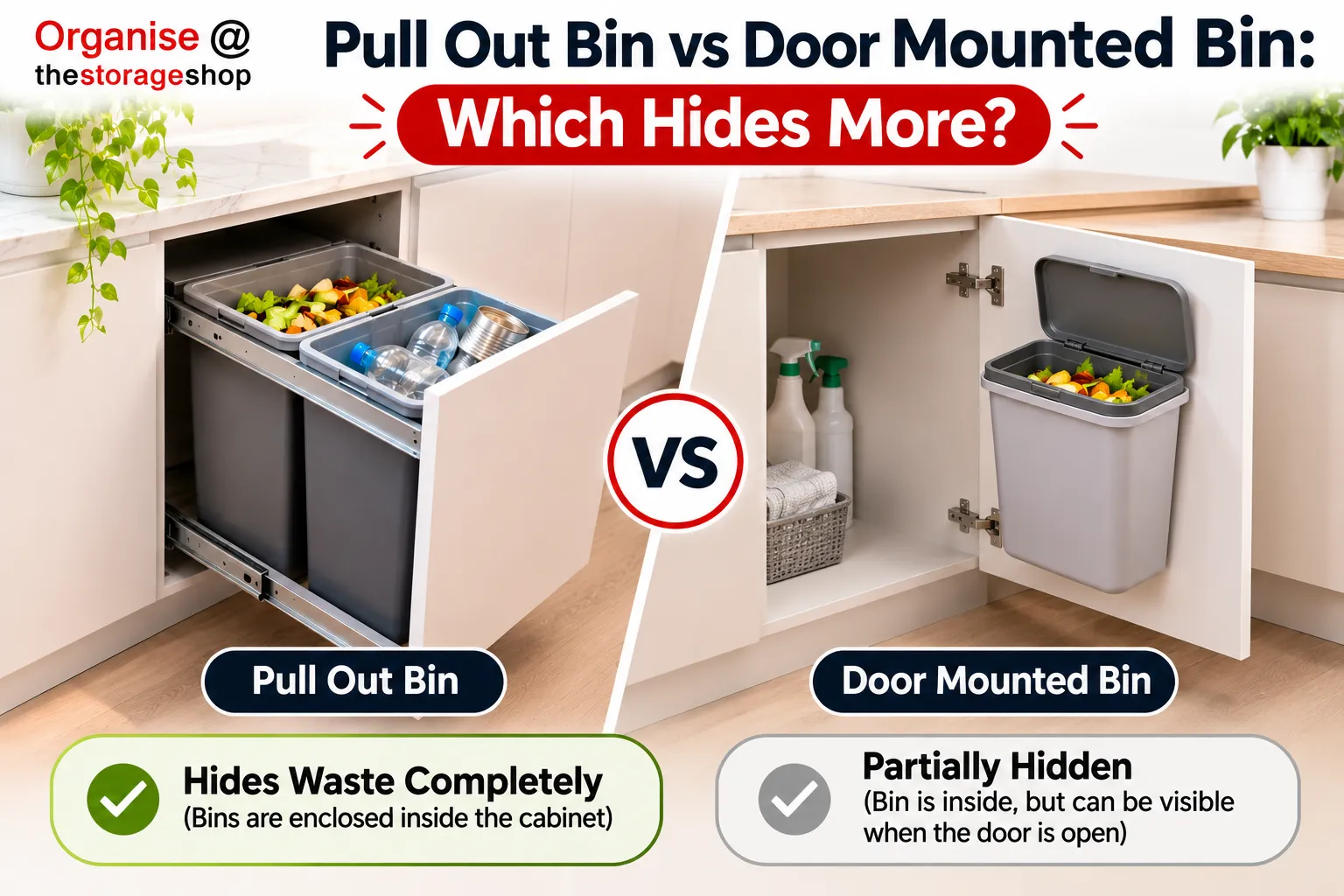
Pull out bin vs door mounted bin: which hides more?
|
Pull out bin |
Door mounted bin (swing-out) |
|
|
Hidden when closed |
Yes |
Yes |
|
Typical capacity |
16–94 litres |
5–20 litres |
|
Buckets |
2–4 |
Usually 1 |
|
Handles recycling too |
Yes |
Rarely |
|
Space needed |
A whole base cabinet |
Inside an existing door |
|
Best for |
Main household bin |
Scraps or small kitchens |
For most households, the pull out bin hides more because it absorbs the recycling as well. A door bin hides one small stream well, but the rest of your rubbish still needs a home.
Design details that keep it hidden
-
Match the front. In a new kitchen, ask for the bin cabinet front to match the doors around it, with the same handle or none at all.
-
Put it where you prep. A bin within a step of the chopping board means scraps don’t get left on the bench. Avoid the cupboard beside the dishwasher, because the open dishwasher door blocks it.
-
Use an island. In kitchens with an island, a pull out bin on the working side keeps rubbish completely out of view from the living area.
-
Choose soft-close. It stops the bin announcing itself every time it closes.
Keeping a hidden bin fresh
A closed cupboard hides smells for a while, but not forever. Empty food scraps every day or two, especially in summer. Rinse the buckets and let them dry before relining. A wipeable mat on the cabinet floor catches drips.
Before you buy
Measure the inside of the cabinet, not the plan size. Side panels are usually 16 mm thick, so a 600 mm cabinet is only about 568 mm inside. Check the depth to any pipes or back panel, and make sure nearby drawers and appliances won’t get in the way of the bin when it’s open.
Frequently asked questions
What is the best hidden kitchen bin for a family?
A double or triple pull out bin in a 450–600 mm base cabinet. It hides rubbish, recycling and food scraps together and holds a few days of waste.
Can a door mounted bin replace a main bin?
Only in very small households. Most swing-out door bins hold 20 litres or less, so they work best for scraps alongside a larger bin.
Do hidden bins smell?
Not if you empty food waste often and keep the buckets clean. The cupboard actually helps contain odours.
The verdict
If you want rubbish completely out of sight, give a pull out bin its own base cabinet, ideally with soft-close runners and a front that matches the kitchen. Use a door mounted bin for scraps or a tight cupboard, and a low bin under the sink where the pipes allow. Measure inside the cabinet first, and the only time you’ll think about the bin is on bin night.
