
A deodorant that smells lovely in the shop can feel very different by Wednesday, when your underarms start to itch. For a lot of people with reactive skin, fragrance is the first thing they suspect, and often they’re right. But it isn’t the whole story, and going fragrance-free doesn’t solve every problem.
If you’re choosing a sensitive skin deodorant, it helps to know how fragrance affects the skin, how to read the label and when a scented product might still be fine.
Quick answer: Fragrance-free is usually the safer starting point for sensitive underarms, because fragrance is one of the most common causes of cosmetic skin allergies. Scented deodorants can still suit people who have used them without trouble. Either way, check the full ingredient list, since other ingredients such as bicarbonate of soda can irritate too.
Fragrance-Free vs Scented at a Glance
|
Fragrance-free |
Scented |
|
|
What’s added for smell |
Nothing |
Parfum, essential oils or both |
|
How it controls odour |
Active ingredients |
Active ingredients, plus scent |
|
Best suited to |
Reactive skin, known fragrance allergy |
People who’ve tolerated fragrance before |
|
Main watch-out |
Other irritants, such as bicarb |
Fragrance allergens |
Why Fragrance Bothers Some Underarms
Fragrance can upset skin in two ways. Irritation happens when an ingredient simply disagrees with the skin, causing stinging, dryness or redness soon after you apply it. An allergy is different: your immune system reacts to a specific substance, often with an itchy rash that can take a day or two to appear. Once you’re allergic, it tends to happen every time you’re exposed.
Underarms make both more likely. The skin is thin, warm, often damp and regularly shaved, and deodorant sits on it for hours.
Does a Deodorant Need Fragrance to Work?
No. Fragrance makes you smell of something; it doesn’t stop odour forming. That job falls to the active ingredients, such as magnesium hydroxide, which neutralises odour, and zinc ricinoleate, which traps odour molecules. A fragrance-free formula with good actives can keep you just as fresh as a scented one.
Fragrance-Free, Unscented and “Natural Scent”: Reading the Label
These words don’t all mean the same thing. “Fragrance-free” means nothing has been added purely for scent. “Unscented” only means the product doesn’t smell of much, and it may contain a masking fragrance to cover the smell of other ingredients.
On the ingredient list, fragrance usually appears as one word: Parfum. Some common fragrance allergens, such as linalool, limonene and citral, must also be named individually above set levels, so you may spot them even in products scented with essential oils.
Are Essential Oils a Safer Choice?
Not necessarily. Lavender, citrus, peppermint and tea tree oils all contain natural fragrance compounds that can trigger reactions. Some, such as limonene and linalool, become more likely to cause allergies as they oxidise on exposure to air. “Plant-based” tells you where an ingredient came from, not how your skin will react to it.
When a Scented Deodorant Can Still Work
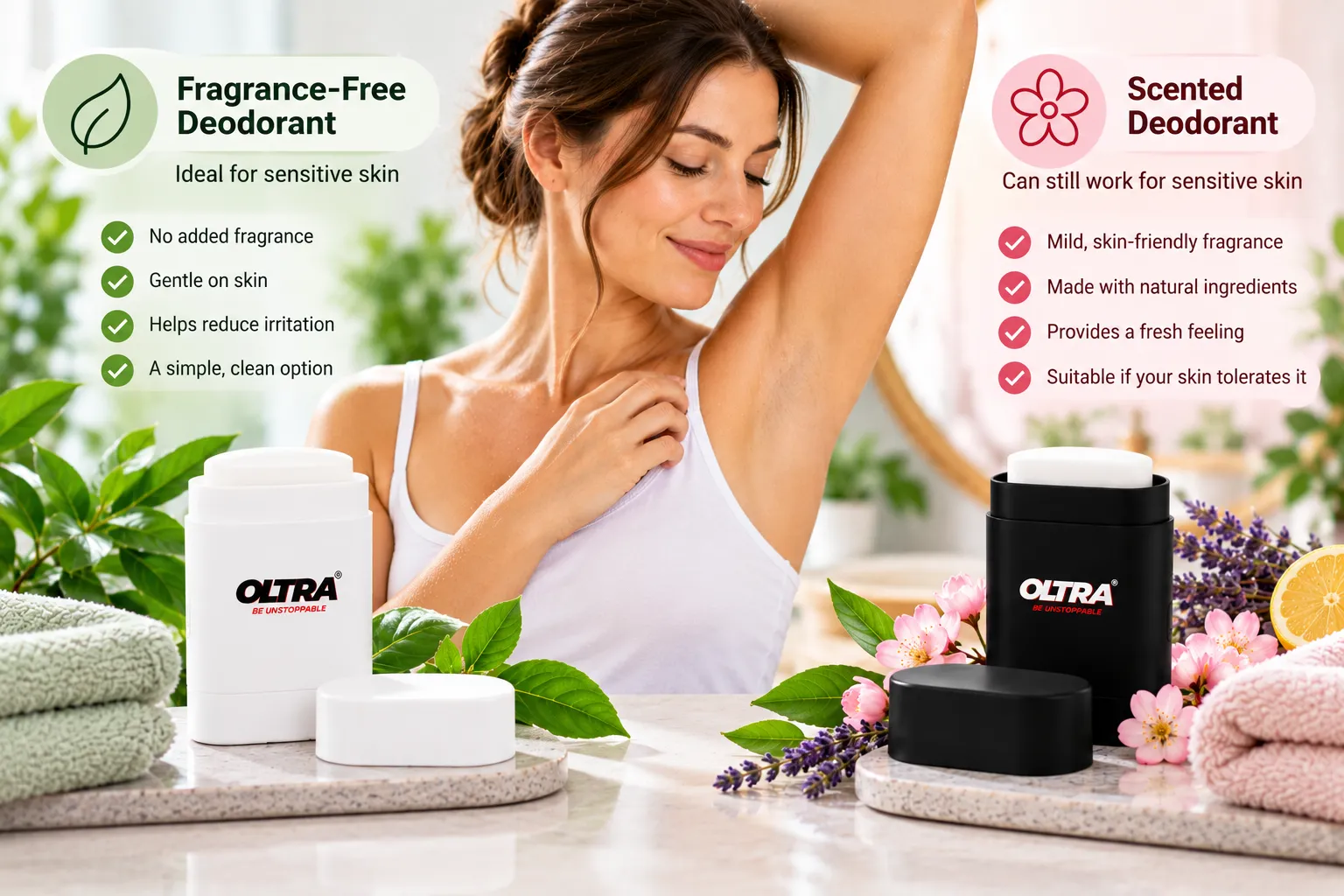
Having sensitive skin doesn’t mean you have to give up scent altogether. If you’ve used a scented product for months without trouble, there’s no need to switch. A scented deodorant for sensitive skin can work well, as long as it doesn’t contain the specific ingredient you react to. If fragrance has caused a rash before, though, stick with fragrance-free rather than experimenting.
How to Try a New Deodorant Without a Flare-Up
-
Check the label for anything that has bothered you before.
-
Try it on a small patch of skin, such as your inner arm, for a few days.
-
Start on calm, unshaven underarms, never on broken skin.
-
Stop straight away if itching, redness or burning appears.
A home trial can’t rule out an allergy that develops later, so if reactions keep coming back, ask your GP about patch testing.
Oltra Guard’s Scent Options
For anyone comparing a natural deodorant for sensitive skin, Oltra Guard lets you decide how much scent you want. Its Core option is fragrance-free, while Rise, Spark, Flow and Ember are scented. There’s also a choice of Standard or Bi-Carb-Free formulas, so you can rule out bicarbonate of soda as well as fragrance. It’s aluminium-free and comes as a reusable applicator with refills. No formula suits every skin, so compare the ingredient list with what you know you react to.
Frequently Asked Questions
What does “parfum” mean on a deodorant label?
Parfum is the standard label name for fragrance. It can cover a blend of many individual scent ingredients, which aren’t usually listed separately. If you’re avoiding fragrance, look for products where neither Parfum nor named fragrance allergens appear.
Is hypoallergenic deodorant better for sensitive skin?
Not always. “Hypoallergenic” suggests a lower chance of allergy, but there’s no fixed standard a product must meet to use the word. It can’t guarantee you won’t react, so the ingredient list is still a more reliable guide than the claim.
Which fragrance ingredients most often cause reactions?
Commonly reported culprits include linalool and limonene, especially once oxidised, along with cinnamal, eugenol, geraniol and citral. You may see these listed by name. A GP or dermatologist can confirm your personal triggers through patch testing.
Does fragrance-free deodorant smell of anything?
It can have a faint smell from its ingredients, such as plant oils or butters, even though nothing has been added for scent. Most people find it barely noticeable once applied, and it won’t clash with any perfume you wear.
Can you use perfume instead of deodorant?
It’s not a good swap. Perfume covers odour briefly but doesn’t stop it forming, and most perfumes are alcohol-based, which can sting underarm skin. Use a deodorant for odour control and spray perfume on your clothes or pulse points instead.
Are scented deodorants bad for you?
For most people, no. Fragrance ingredients are permitted in UK cosmetics within set limits and many people use them daily without problems. The issue is individual sensitivity: if fragrance gives you a rash, avoid it, but there’s no need to fear it otherwise.
Final Thoughts
Fragrance-free is the sensible default if your underarms react easily, but it isn’t a magic fix and scented products aren’t automatically off-limits. Read the label, know your own triggers and judge any deodorant by how your skin feels after a normal week.
